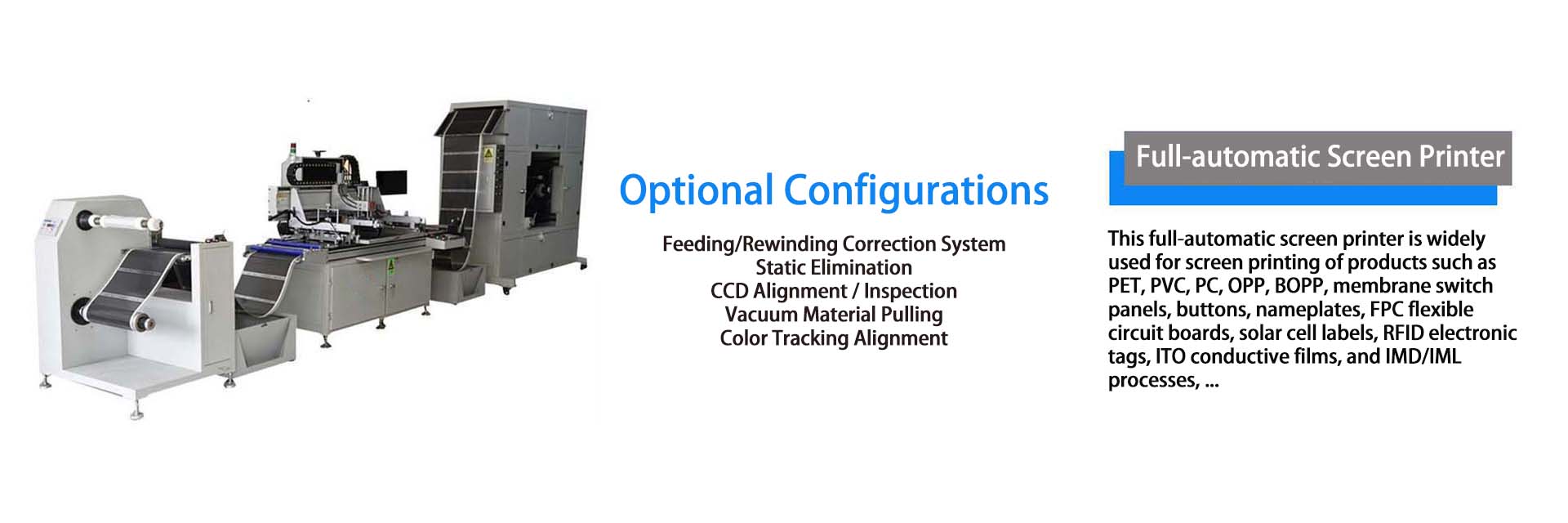
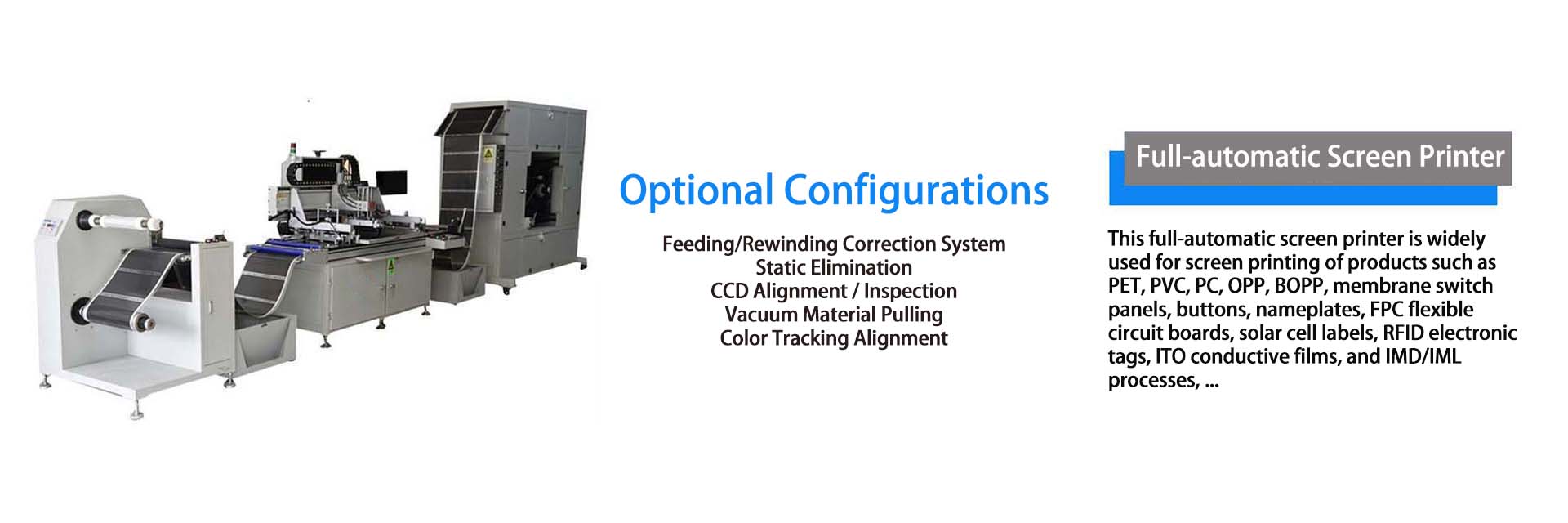
Shield Full-Automatic Screen PrinterElectrothermal Film Production Equipment
Tension Variation in the Winding Process of Fully Automatic Screen Printing Machines
Column:Insights Brand: Hengchuanqi Service Hotline:+86-13352849401
Tension Variation in the Winding Process of Fully Automatic Screen Printing Machines
In the production process of fully automatic screen printing machines, the winding system is a key link connecting the "printing process" with "finished product storage/subsequent processes". **Winding tension** is a core parameter that determines winding quality, printing precision, and material utilization. Tension is not constant during winding; its dynamic fluctuation directly affects final product quality (e.g., overprinting deviation, material wrinkling, stretching deformation). This article analyzes the core causes, potential impacts, and targeted stable control strategies of tension variation in the winding process of fully automatic screen printing machines.
1. Core Role of Winding Tension: Why Focus on Its Stability?
Before discussing tension variation, it is necessary to clarify the basic value of "stable winding tension"—it is the prerequisite for ensuring the continuity of screen printing production and product consistency:
1. Ensure printing precision without deviation: During screen printing, substrates (e.g., films, paper, metal foils) must maintain a constant tension state. If winding tension fluctuates, the substrate is prone to "instantaneous stretching" or "local slack", leading to overprinting misalignment of printed patterns (especially in multi-color overprinting) and damaging graphic precision.
2. Achieve neat winding without defects: Stable tension enables uniform winding of the substrate on the winding shaft, avoiding issues such as "interlayer slippage", "uneven edges", and "bulging". Insufficient tension causes loose winding and substrate wrinkling; excessive tension leads to extrusion deformation of inner-layer materials.
3. Protect the physical properties of the substrate: Different substrates (e.g., PET films, PC boards, thin aluminum foils) have varying tensile strengths. If tension fluctuation exceeds the substrate’s tolerance range, permanent stretching deformation (e.g., film thinning, paper fiber breakage) or even direct fracture may occur, causing production interruption and material waste.
2. Core Causes of Tension Variation During Winding
Tension variation in the winding process of fully automatic screen printing machines is not random; its roots lie in four categories: **winding system characteristics, material properties, mechanical status, and process parameters**.
# 2.1 Dynamic Increase of Winding Diameter: Core Physical Cause of Tension Variation
The essence of the winding process is "the substrate is continuously wound around the winding shaft, with the roll diameter increasing from the initial 'empty shaft diameter' to the 'full roll diameter'". This physical process is the primary cause of tension fluctuation:
- According to the linear velocity formula $v = \pi d n / 60$ ($v$ = substrate linear velocity, $d$ = real-time winding diameter, $n$ = winding shaft speed), if the winding shaft speed $n$ is constant, the substrate linear velocity $v$ increases as the roll diameter $d$ increases—at this point, the substrate is "over-stretched", and tension rises accordingly.
- Conversely, if the system fails to adjust the speed in time, the linear velocity $v$ is low when the roll diameter $d$ is small, leading to substrate slack and tension reduction.
# 2.2 Differences in Substrate Properties: "Material-Side" Cause of Tension Fluctuation
The physical properties (elastic modulus, thickness uniformity, surface friction coefficient) of different substrates directly cause adaptive tension changes during winding:
- Elastic modulus difference: Substrates like PET films (high elasticity) and rigid PVC boards (low elasticity) behave differently. The former is prone to "elastic deformation" under the same tension; slight tension fluctuation during winding quickly translates to tension changes. The latter has high rigidity, so tension fluctuation tends to cause "local stress concentration", further exacerbating tension unevenness.
- Poor thickness uniformity: If the substrate has "thickness deviation" (e.g., a film section is 10% thicker than the standard), local tension surges during winding due to "physical thickness superposition", leading to slack in adjacent areas.
- Surface friction coefficient variation: Oil stains or uneven coatings on the substrate surface cause fluctuations in the interlayer friction coefficient, leading to "slippage" during winding and instantaneous tension drop.
# 2.3 Mechanical System Errors: "Equipment-Side" Cause of Tension Fluctuation
The mechanical precision of the winding system directly affects the stability of tension transmission. Common error sources include:
- Winding shaft concentricity deviation: If the winding shaft has eccentricity during processing or installation (e.g., radial runout > 0.1mm), "periodic radial force" is generated during rotation, causing "pulsating tension fluctuation" with the shaft’s rotation cycle.
- Transmission system backlash: Backlash in the transmission chain (e.g., gears, timing belts, couplings) between the winding motor and the winding shaft prevents the motor’s torque from being fully transmitted to the winding shaft, resulting in "torque lag"—tension shows "delayed fluctuation" when the motor accelerates/decelerates (e.g., tension first decreases then increases during acceleration).
- Abnormal guide roller status: Worn, contaminated, or misaligned guide rollers (before winding) exert "additional resistance" or "lateral force" on the substrate, causing tension unevenness before winding, which is then transmitted to the winding process.
# 2.4 Improper Process Parameter Setting: "Operation-Side" Cause of Tension Fluctuation
The rationality of process parameters directly determines tension control precision. Common setting issues include:
- Initial tension deviation: Excessively high initial tension (exceeding the substrate’s tensile limit) causes tension to increase with roll diameter during winding, leading to substrate stretching deformation. Insufficient initial tension results in loose full-roll winding and interlayer slippage.
- Mismatched acceleration/deceleration parameters: During machine startup/shutdown or roll change, excessively short acceleration/deceleration time of the winding motor causes "sudden changes" in substrate linear velocity and "impact tension" (e.g., instantaneous tension peak during startup is 2-3 times the stable value). Excessively long acceleration/deceleration time leads to substrate accumulation and sudden tension drop.
- Lack of tension compensation parameters: Some equipment does not set "tension compensation coefficients" based on substrate properties (e.g., thickness, elasticity). When the substrate is replaced, the system still uses old parameters, resulting in mismatched tension and material requirements.
3. Specific Impacts of Abnormal Tension Variation on Screen Printing Production
If tension fluctuation exceeds the process tolerance range (usually requiring tension fluctuation error ≤ ±5%), it causes negative impacts in three dimensions: **print quality, production efficiency, and material loss**.
# 3.1 Print Quality Defects: Most Direct Consequence
- Overprinting misalignment: Tension fluctuation causes instantaneous stretching/slack of the substrate. During multi-color screen printing, subsequent colors cannot align with previous ones, resulting in "ghosting" and "offset" (overprinting deviation > 0.1mm is deemed unqualified).
- Graphic deformation: Excessive tension stretches the substrate (especially films), elongating printed graphics along the tension direction (e.g., circular patterns become elliptical). Insufficient tension causes substrate slack and "compression deformation" of graphics.
- Surface defects: Insufficient tension leads to loose winding and air entrapment between layers (forming "bubbles"). Excessive tension causes extrusion of inner-layer materials (forming "indentations"). Tension fluctuation accompanied by substrate deviation results in "edge missing printing" or "graphic trimming".
# 3.2 Reduced Production Efficiency: Increased Hidden Costs
- Frequent shutdowns for adjustment: Print defects caused by tension fluctuation require shutdowns to inspect the tension system (e.g., calibrating sensors, adjusting parameters). Each shutdown takes 10-30 minutes, seriously affecting production line rhythm.
- Reduced roll change efficiency: Unstable tension causes "uneven full-roll edges", requiring additional edge processing in subsequent processes (e.g., slitting, rewinding) and increasing process time. Loose winding requires rewinding, wasting man-hours.
# 3.3 Increased Material Loss: Direct Economic Loss
- Substrate fracture and waste: Sudden tension surges exceeding the substrate’s tensile strength cause direct fracture, scrapping printed semi-finished products. The material loss rate per roll can reach 10%-20%.
- Increased scrap: Unqualified products due to uneven winding or print defects require edge cutting or full-roll scrapping. High-value substrates (e.g., conductive films, metal foils) significantly increase production costs.
4. Key Control Strategies for Stable Winding Tension
To address the above causes of tension variation, a closed-loop control system must be established from three levels—**system design, mechanical maintenance, and process optimization**—to achieve dynamic stability of winding tension.
# 4.1 Adopt "Closed-Loop Tension Control System": From "Passive Adaptation" to "Active Regulation"
Mainstream fully automatic screen printing machines currently use **closed-loop tension control**, with the core logic of "real-time detection → deviation comparison → dynamic correction", divided into two types:
- Tension sensor feedback control: A tension sensor (e.g., strain gauge type, dancer roll type) is installed at the guide roller before winding to collect real-time actual tension values and compare them with the set tension. If there is a deviation, the system immediately adjusts the winding motor speed (e.g., reducing speed as the roll diameter increases to maintain stable linear velocity), ensuring tension returns to the set value. This method has high precision (fluctuation error ≤ ±3%) and is suitable for high-precision screen printing (e.g., electronic labels, membrane switches).
- Roll diameter calculation feedback control: An encoder detects the winding shaft’s speed and rotation angle in real time. Combined with the initial roll diameter and substrate thickness, the real-time roll diameter is calculated ($d_{real-time} = d_{initial} + 2 \times n \times t$, where $n$ = number of winding turns, $t$ = substrate thickness). The system automatically adjusts the motor torque based on roll diameter changes to maintain stable tension. This method has low cost and is suitable for scenarios with low precision requirements (e.g., ordinary paper screen printing).
# 4.2 Introduce "Taper Tension Control": Match Tension Requirements for Increasing Roll Diameter
During winding, inner-layer substrates are squeezed by outer-layer materials. Constant tension causes inner-layer deformation. The core of **taper tension control** is "gradually reducing tension as the roll diameter increases":
- Set "initial tension" and "full-roll tension" (usually full-roll tension is 50%-80% of initial tension). The system gradually reduces tension along a linear or non-linear curve (e.g., exponential curve) as the roll diameter increases.
# 4.3 Optimize Mechanical System Precision: Reduce "Equipment-Side" Tension Fluctuation Sources
- Regularly calibrate winding shaft concentricity: Check the radial runout of the winding shaft every 3-6 months. If the deviation > 0.05mm, repair it with a lathe or replace the bearing sleeve to meet concentricity requirements.
- Eliminate transmission system backlash: Regularly inspect gear and timing belt wear. Replace worn components if backlash is excessive. Lubricate couplings to reduce torque transmission lag. High-precision equipment can use "backlash-free gearboxes" or "direct-drive motors (DD motors)" to completely eliminate transmission backlash.
- Maintain guide rollers and tension sensors: Clean the guide roller surface weekly (to avoid friction coefficient changes caused by contamination) and check guide roller parallelism (deviation ≤ 0.1mm/m). Calibrate tension sensors monthly to ensure detection precision.
# 4.4 Refine Process Parameter Setting: Adapt to Tension Requirements of Different Substrates
- Match substrate properties with tension: Set initial tension based on the substrate’s tensile strength and elastic modulus (e.g., 5-10N for thin films, 15-25N for thick paper, 20-30N for metal foils). Verify via small-batch test printing (reduce tension if stretching deformation occurs; increase tension if winding is loose).
- Optimize acceleration/deceleration parameters: Adjust acceleration/deceleration time based on substrate thickness (e.g., 1-2 seconds for thin substrates, 3-5 seconds for thick substrates) to avoid "impact tension". Some equipment can enable the "soft start/soft stop" function to further buffer tension fluctuation.
- Establish a parameter database: Record optimal tension parameters (initial tension, taper coefficient, acceleration/deceleration time) for different substrates (e.g., PET, PC, paper) and prints (e.g., single-color, multi-color) for direct use in subsequent production, reducing trial-and-error costs.
5. Conclusion
Tension variation during the winding process of fully automatic screen printing machines is the result of the combined action of "physical laws (roll diameter increase), material properties, equipment precision, and process parameters". Its core harms include not only print quality defects but also reduced production efficiency and material waste. To achieve stable winding, a complete "detection-control-feedback" system must be built, with "closed-loop tension control + taper tension adjustment" as the core, combined with mechanical system maintenance and process parameter optimization.
As screen printing technology advances toward "high precision, high speed, and wide width" (e.g., flexible circuit board printing in the new energy field), the requirement for winding tension control precision will further increase. In the future, "AI adaptive control" (automatically matching tension parameters for different substrates via machine learning) may be introduced to further reduce manual intervention and achieve "unmanned stable control" of winding tension.
I can further optimize the terminology accuracy of specific sections (e.g., mechanical components, control algorithms) based on your industry standards. Do you need me to generate a **simplified English summary** of this article for quick communication with overseas teams?

Shenzhen Hengchuanqi Precision Machinery Co., Ltd.
Mobile:+86-13352849401 Email:hcqhe@qq.com
Company Headquarters:Building 3, Maozhouhe Industrial Zone, Shapuwei, Songgang Town, Bao'an District, Shenzhen City, Guangdong Province, China
Dongguan Base:No. 11, Zhenye Street, Lingxia, Liaobu Town, Dongguan City, Guangdong Province, China
WeChat
Mobile Version