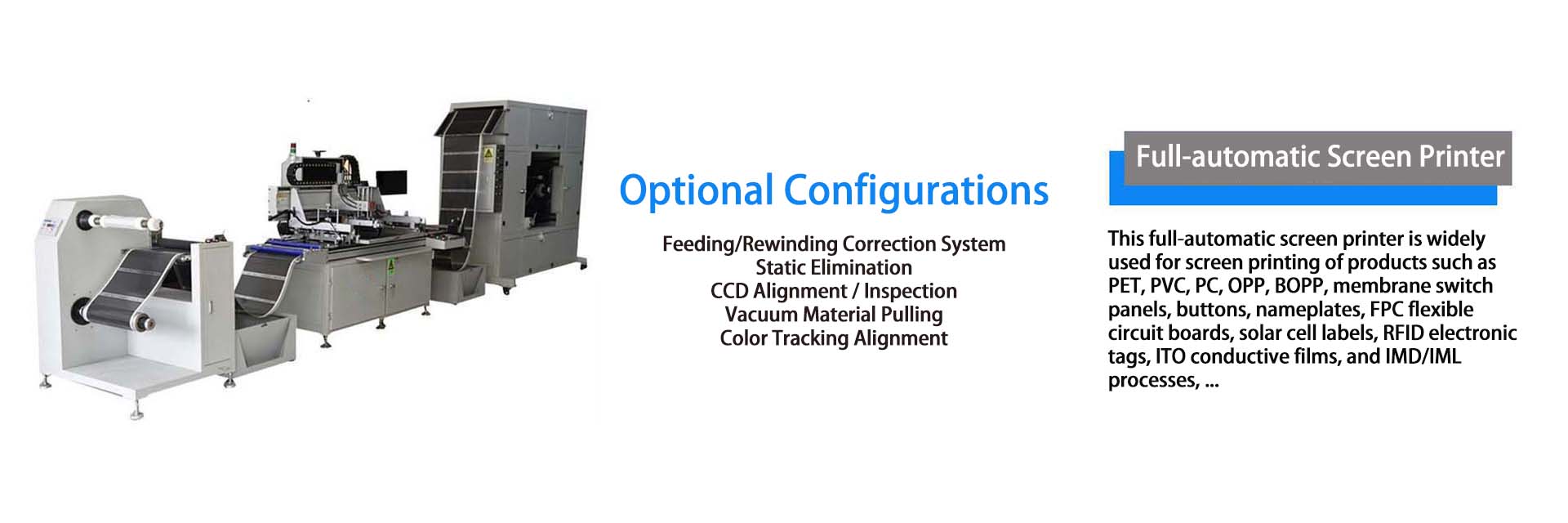
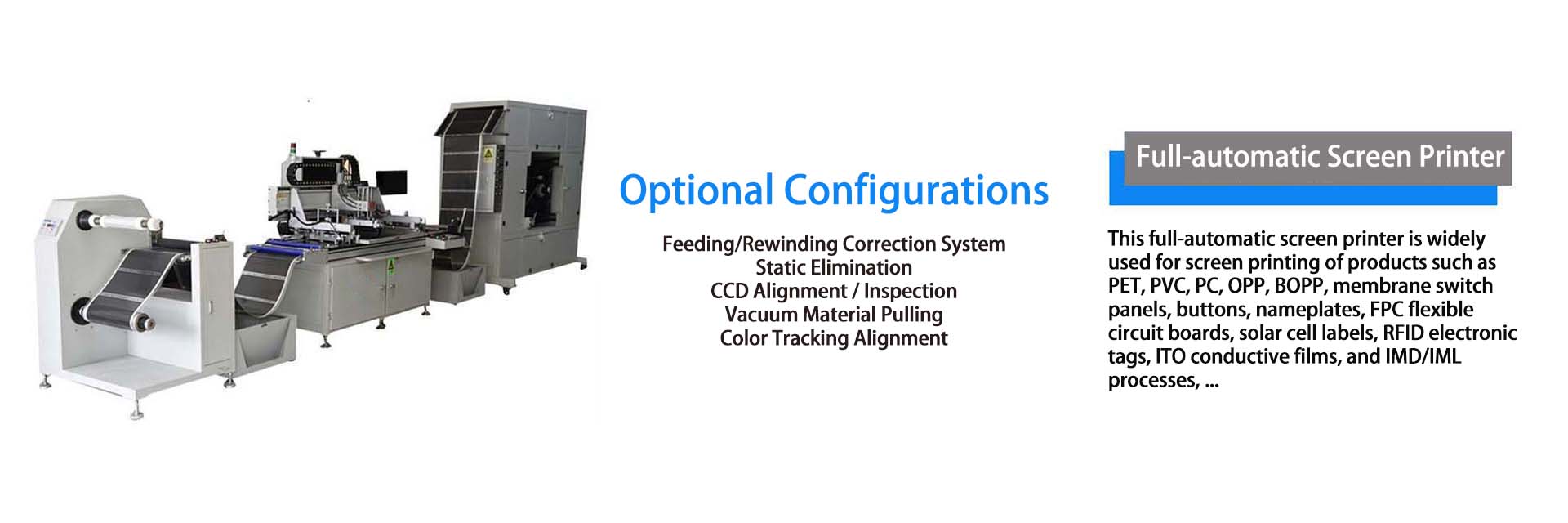
Shield Full-Automatic Screen PrinterElectrothermal Film Production Equipment
Heat Sink Screen Printing: The Craft of Heat Dissipation Assurance in Compact Dimensions
Column:Technical News Brand: Hengchuanqi Service Hotline:+86-13352849401
Heat Sink Screen Printing: The Art of Thermal Management Assurance in Compact Dimensions
In an era of increasing miniaturization and high performance of electronic devices, heat sinks—critical components for heat conduction—directly impact device stability and lifespan. Screen printing, a seemingly traditional process, plays an indispensable role in heat sink manufacturing. It not only precisely renders circuit patterns and identification information but also enhances heat dissipation efficiency via special coatings, serving as a key bridge between thermal functionality and process precision.
Unique Value of Heat Sink Screen Printing
The core function of heat sinks is to rapidly dissipate device-generated heat, and screen printing fulfills multiple roles in this process:
- Printing conductive inks to form simple circuits or electrodes, enabling integrated thermal and circuit design—ideal for miniaturized electronic components.
- Printing high-temperature-resistant markings (e.g., model numbers, parameters, safety warnings) that remain legible in extreme temperatures, facilitating product traceability and maintenance.
- Applying functional inks (e.g., graphene thermal coatings) to boost heat conduction efficiency by 10%-20%.
Compared to other printing processes, screen printing offers distinct advantages for heat sink processing: compatibility with substrates like aluminum, copper, and stainless steel; adaptability to flat or slightly curved surfaces; controllable coating thickness (10-100μm) to balance cost and performance; and high productivity, suitable for mass production to meet electronics industry scale demands.
Complete Process of Heat Sink Screen Printing
Preparations: "Adaptation Revolution" of Substrates and Inks
Heat sink surfaces often have oxide layers, oil, or metal debris from stamping, which severely reduce ink adhesion. Thus, pretreatment is critical: ultrasonic cleaning removes oil, followed by sandblasting or chemical etching to increase surface roughness (Ra 1.6-3.2μm), providing an "anchoring" base for inks.
Ink selection depends on operating environments:
- Ceramic-based inks (withstanding >200℃) for high-temperature equipment (e.g., automotive engine cooling systems).
- Silver/copper pastes for conductivity, requiring post-print conductivity ≥10⁵ S/m.
- UV-curable inks (fast-drying, scratch-resistant) for markings.
Screen Fabrication: Balancing Precision and Durability
Screens use polyester or stainless steel mesh (200-400 mesh)—higher mesh counts improve pattern precision but reduce ink transmittance. Photosensitive emulsion exposure/development ensures jagged-free edges, with line width tolerance ≤±0.05mm for circuits to prevent short/open circuits.
Printing Operation: "Micron-Level Battle" of Parameter Control
Pretreated heat sinks are fixed on the printing table via locating pins or vacuum adsorption. Polyurethane squeegees (60-80 Shore A hardness) operate at 3-8kg/cm² pressure and 30-50mm/s speed to ensure uniform ink transfer without bubbles. Post-print inspection checks for missing prints or smearing, with timely screen cleaning.
Curing: "Final Mile" of Performance Stability
Curing varies by ink type:
- Solvent-based inks: Oven curing at 60-80℃ for 10-15 minutes.
- UV-curable inks: 365nm UV lamp exposure for 3-5 seconds.
- High-temperature ceramic inks: Sintering at 150-200℃ for 30 minutes to form chemical bonding with substrates.
Cured coatings require adhesion grade ≥3B (cross-cut test) to resist peeling under long-term thermal expansion/contraction.
Key Technologies and Quality Control
Addressing Printing Deviation from Thermal Deformation
Minor metal heat sink deformation (flatness error >0.1mm/m) causes pattern misalignment. Elastic squeegees (50-60 Shore A) with vacuum platforms compensate for substrate unevenness via micro-deformation, ensuring ±0.1mm printing accuracy.
Enhancing Ink Adhesion on High Thermal Conductivity Substrates
Low surface tension of copper/aluminum causes ink shrinkage. Solutions include:
- Adding 0.5%-1% silane coupling agent to inks for stronger metal bonding.
- Low-temperature pre-baking (40℃, 5 minutes) to release solvents gradually and reduce bubbles.
Core Quality Inspection Indicators
- **Appearance**: 20x magnification checks for no broken lines, pinholes, or burrs.
- **Functionality**: Conductive coatings require resistance <0.1Ω/cm; thermal coatings need thermal conductivity ≥10 W/(m·K).
- **Environmental Resistance**: No cracking/peeling after 100 thermal shock cycles (-40℃ to 125℃), with stable performance.
Applications and Future Trends
Heat sink screen printing is widely used in consumer electronics (CPU heat sinks, smartphone motherboard coolers), automotive electronics (engine radiator fins, on-board inverter cooling parts), and industrial equipment (frequency converter heat sinks, laser power radiators).
Driven by 5G and new energy industries, demand for integrated heat sinks is rising, pushing screen printing toward "multi-functional composite printing"—e.g., simultaneous printing of conductive circuits, thermal coatings, and QR codes for "one print, multiple functions."
Future advancements will include nano-inks: graphene-based conductive inks may reduce line resistance by 50%, while carbon nanotube thermal coatings could achieve ≥50 W/(m·K) thermal conductivity. Automated lines with visual positioning and in-line inspection will boost yields, expanding screen printing’s role in precision manufacturing.
From micron-level circuit lines to high-temperature functional coatings, heat sink screen printing—with its unique process advantages—builds a precise thermal management system in compact spaces. It embodies the fusion of technology and craftsmanship, where every uniform ink transfer and precise pattern ensures stable operation of electronic devices.

Shenzhen Hengchuanqi Precision Machinery Co., Ltd.
Mobile:+86-13352849401 Email:hcqhe@qq.com
Company Headquarters:Building 3, Maozhouhe Industrial Zone, Shapuwei, Songgang Town, Bao'an District, Shenzhen City, Guangdong Province, China
Dongguan Base:No. 11, Zhenye Street, Lingxia, Liaobu Town, Dongguan City, Guangdong Province, China
WeChat
Mobile Version